












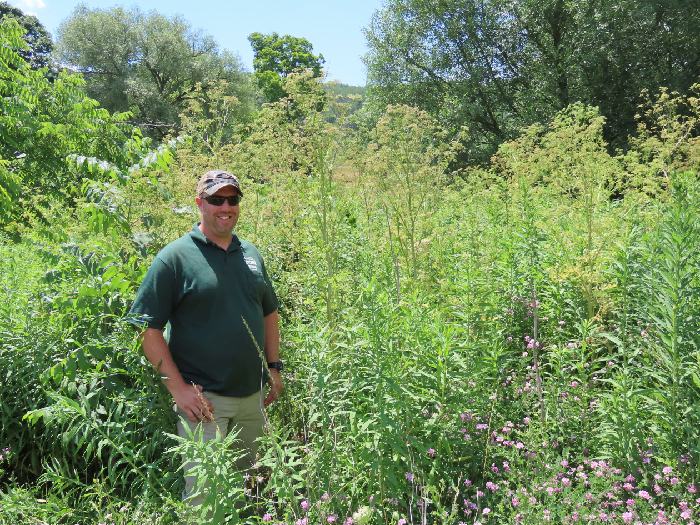
(Tioga County, PA) – The Northern Tier of Pennsylvania has a new resident, and it’s not welcome. Poison hemlock, a member of the parsley family, is commonly found in southern portions of the state. Unfortunately, there’s been a notable expansion of it in the northern portion of its range, including Tioga County and surrounding areas.
Originating in Europe and Northern Africa, it was introduced to the United States in the 1800s as a garden plant. But as its name suggests, poison hemlock is incredibly toxic.
All parts of this plant contain toxic alkaloids. Eating any part of it, such as the seeds, leaves, flowers or fruits, can cause respiratory failure and death in humans and livestock. Inhalation of plant particles and direct contact with the skin should be avoided.
Due to the similarities of poison hemlock to edible plants and its proximity to residential areas, identification is key to avoiding exposure.
Poison hemlock frequently occurs along roadways, in disturbed soils, and adjacent to agricultural fields. The plant is biennial, reaching heights of 3-8 feet tall. It blooms from May through August, forming small white flowers in umbrella-shaped clusters. The leaves are fern-like and triangular; the stem smooth and blotched with purple.
It may be mistaken for Queen Anne’s lace, common ragweed, and wild parsnip, among others. Occasionally, it’s confused with edible plants, such as parsley and anise.
Dry stems are thought to remain toxic for up to 3 years, so care should be taken in agricultural settings to ensure the plants aren’t being harvested with hay or grain crops.
Poison hemlock is prolific. Each plant produces over 30,000 seeds in a single year. In Pennsylvania, it’s listed as a Class B noxious weed, meaning it’s widely established and cannot feasibly be eradicated, but control is a necessary step to reduce human exposure, decrease the possibility of contaminated livestock forage, and slow the spread.
Herbicides can be an effective control method before seed formation.
If seeds are present, the best control method is to carefully cut and bag the seed heads, let them bake in the sun, and then dispose of them. Be sure to wear personal protective equipment including gloves and long sleeves when handling any part of the plant. Seeds remain viable in the soil for up to 6 years so management must be ongoing.
“As far as we know, we don’t have it on state forestland, and we don’t want it,” said Chris Firestone, botanist with the DCNR Bureau of Forestry office at Wellsboro.
Anyone who thinks they’ve found poison hemlock in the Tioga State Forest in Tioga County is asked to contact the DCNR office at Wellsboro by calling 570-724-2868 .
Those with questions about forest management and plant identification on private land in Tioga County are asked to call DCNR Service Forester Marshall Hamilton at 570-724-8128 .
For additional resources, call the Natural Resources Conservation Service at 570-948-4111 or stop in at 50 Plaza Lane in Wellsboro.
Those who live in other Pennsylvania counties that find poison hemlock in forests or on private land and want more information should contact their local district bureau of forestry office or local NRCS office.